


Blog

  • Venue Sourcing Versus Direct Booking Explained

    Venue Sourcing Versus Direct Booking Explained

    A venue can look ideal until the delegate bedrooms are in a separate building, the meeting room turnaround is too tight, or the minimum food and beverage spend changes the budget. That is why venue sourcing versus direct booking is not simply a question of who sends the enquiry. It is about deciding how much time, knowledge and support your team needs to make a sound choice.

    For a straightforward meeting at a familiar hotel, booking direct may be entirely sensible. For a conference, member event, training programme or dinner with several moving parts, using an experienced venue finder can remove a considerable amount of work. The right approach depends on the brief, the risks involved and the capacity within your team.

    What direct booking involves

    Direct booking means contacting a hotel, conference venue or event space yourself, either through its website, by email or by speaking to its events team. The organiser manages the research, sends the brief, compares proposals, asks follow-up questions and handles the booking process with the venue.

    There are good reasons to take this route. If you use the same venue regularly and already know its rooms, service standards and contract process, a direct relationship can be efficient. It can also work well for a small internal meeting where dates are flexible, requirements are limited and the organiser has the time to manage the details.

    Direct contact may give you a useful conversation with the team delivering the event. You can explain your organisation’s preferences first-hand and build knowledge that helps with future bookings.

    The limitation is that the organiser only sees the options they know to search for. Finding comparable venues, checking availability and assessing proposals takes time, particularly when a preferred venue cannot accommodate the date, numbers or accommodation requirement. What appears to be a quick enquiry can become a series of emails, calls and spreadsheet comparisons.

    Venue sourcing versus direct booking: the practical difference

    Venue sourcing begins with the brief rather than a single venue. A venue finding partner takes time to understand the purpose of the event, delegate profile, location, dates, budget expectations, room layouts, accommodation, access needs and any non-negotiables. They then identify and approach suitable venues on your behalf.

    The practical difference is breadth and administration. Rather than your team researching every possible location, chasing responses and interpreting different proposals, you receive a considered shortlist of options that meet the agreed requirements. This is particularly useful when the event needs bedrooms, several meeting spaces, an evening dinner, exhibition space or reliable transport links.

    A good venue finder should not simply send a long list of properties. The value lies in judgement: knowing when a city-centre hotel will suit a committee meeting better than a large conference venue, when residential training needs a more self-contained setting, or when a venue’s apparent day rate does not reflect the full cost of the event.

    For organisations with limited internal resource, that judgement can be as useful as the time saved. An executive assistant, membership manager or operations lead may be highly capable of arranging events, but still have a full role to deliver alongside them. Venue sourcing gives them experienced support without requiring another permanent member of staff.

    Time is often the deciding factor

    The cost of arranging an event is not limited to the venue invoice. There is also the time spent defining the requirement, researching options, issuing enquiries, answering venue questions, comparing packages, checking contracts and keeping colleagues informed.

    For a one-off board meeting for ten people, this may be manageable. For an annual conference involving delegates from across the UK, it can take many hours before a venue is even selected. If the organisation runs several meetings, training days or member events each year, the administration quickly becomes a recurring operational burden.

    Using a venue sourcing service does not mean handing over all control. The organiser still makes the final decision. It means the early research and venue communication are managed more efficiently, with one point of contact helping to keep the process moving.

    This can be especially helpful when dates are urgent. Availability changes quickly, and a prompt, well-defined enquiry gives venues the information they need to respond accurately. It also avoids the common situation where several colleagues contact venues separately, creating confusion internally and externally.

    Choice matters, but so does fit

    A wider choice of venues is useful only when it is relevant. A stylish space may impress on a website but be unsuitable for delegates travelling by train, attendees with accessibility requirements or a programme that needs breakout rooms close to the main room.

    When booking direct, it is easy to be guided by familiarity, a convenient location or an initial headline price. Those factors matter, but they are only part of the decision. A venue should also work for the way the event will run.

    For example, a professional body holding a member conference may need a registration area, space for sponsors, clear signage, reliable audiovisual provision and bedrooms for speakers. An SME planning a leadership away day may place more value on privacy, an informal atmosphere and time away from day-to-day interruptions. Neither brief is better, but they require different venue choices.

    A venue sourcing partner can ask the questions that are sometimes missed at the start: How much space is needed between sessions? Will delegates arrive the night before? Is there enough room for confidential conversations? Does the proposed layout support the agenda? Are there hidden logistical pressures around parking, loading or dietary requirements?

    Comparing costs fairly

    Direct booking can feel like the simplest way to control costs because you are speaking to the venue yourself. However, fair comparison requires looking beyond the advertised day delegate rate or bedroom price.

    One proposal may include room hire, refreshments and audiovisual equipment, while another lists these separately. One hotel may offer a lower bedroom rate but have limited meeting space, leading to extra room hire. A venue may be available on the right date but require a minimum spend that does not suit the event format.

    The aim is not always to find the lowest figure. It is to understand the total commitment and whether it delivers what the event needs. A well-presented comparison should make inclusions, exclusions and practical compromises clear, allowing decision-makers to choose with confidence.

    This is also where timing matters. If dates and location are fixed, availability may be more valuable than extensive negotiation. If the event has flexibility, there may be more scope to consider alternative dates, nearby locations or different venue types. The best route depends on what can genuinely move within the brief.

    When direct booking is the better option

    Direct booking remains a sensible choice when the event is small, low-risk and familiar. It may suit an internal meeting at a venue you have used successfully before, particularly if the requirements have not changed and your team has capacity to manage the booking.

    It can also be appropriate where an organisation has a specific reason to use one location, such as a long-standing annual event, an existing relationship or a venue chosen for its connection to the audience. In these cases, the focus may be less on finding alternatives and more on confirming the practical details early.

    Even then, it is worth revisiting the brief rather than repeating last year’s arrangement by default. Delegate numbers, travel patterns, accessibility needs and programme expectations can change.

    When venue sourcing adds most value

    Venue sourcing is particularly useful for new destinations, larger groups, multi-day events and requirements involving accommodation. It is also valuable when an internal team is short on time, when several stakeholders need to agree the decision, or when the first-choice venue is unavailable and a credible alternative is needed quickly.

    For organisations arranging events internationally, the benefit can be greater still. Local knowledge, time zones, accommodation requirements and unfamiliar venue formats create more questions to manage. A clear brief and a single experienced contact help keep the search focused while retaining oversight of the final choice.

    At Craven Business Solutions, the approach is practical: understand what the event needs to achieve, identify appropriate options, reduce the enquiry and comparison work, and support the client at the level they require. For some, that is venue finding alone. For others, it may extend to delegate communications, accommodation requirements or event administration.

    The most useful question is not whether venue sourcing or direct booking is universally better. Ask whether your team has the time, market knowledge and headspace to give this event the attention it deserves. If the answer is uncertain, getting experienced support at the venue search stage can make the rest of the event easier to deliver.
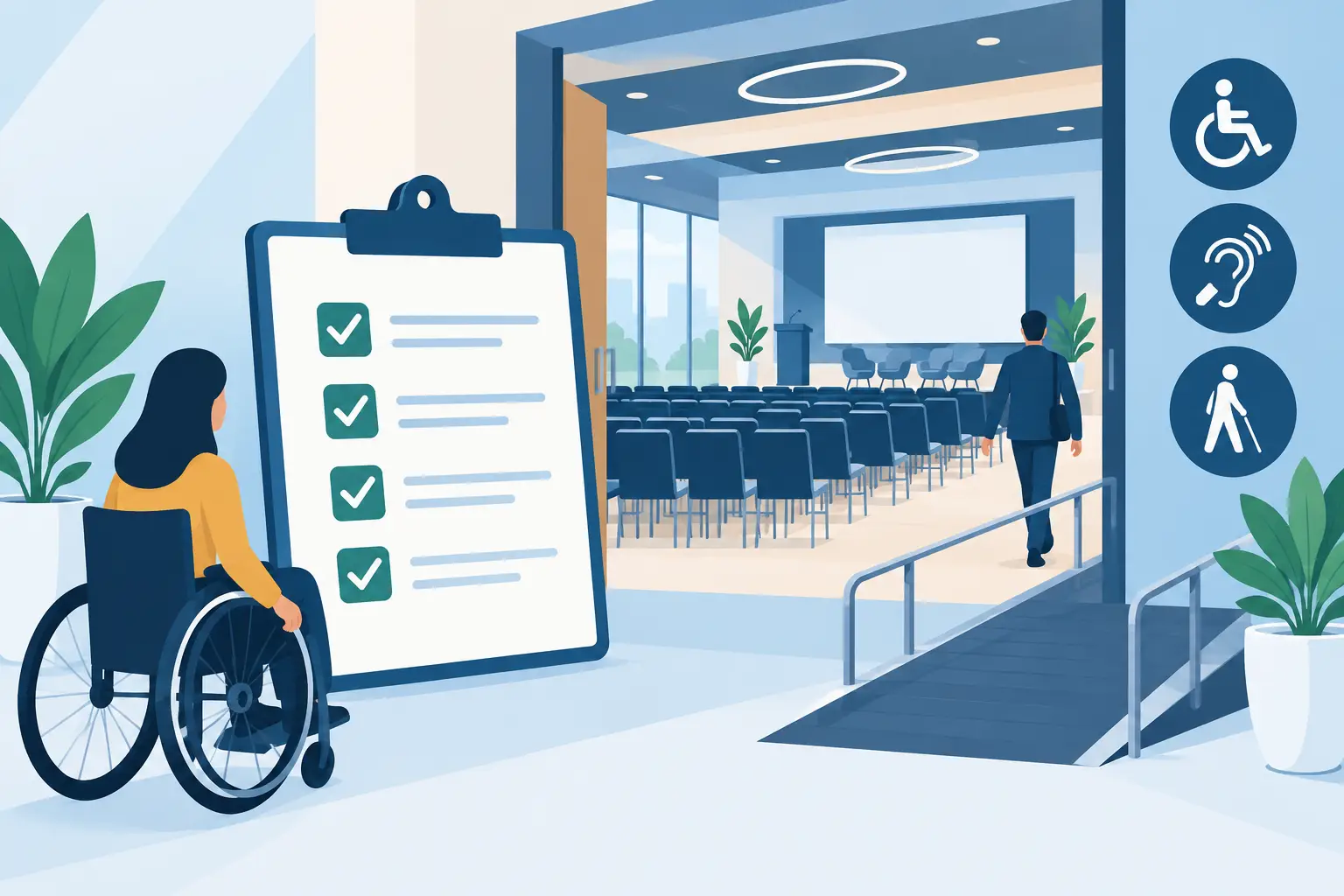

  • Conference Venue Accessibility Checklist

    Conference Venue Accessibility Checklist

    A conference venue accessibility checklist should be part of the brief from the outset, not a final question asked once a venue looks suitable. A smart location can still create avoidable barriers if delegates cannot enter independently, move comfortably between rooms, use facilities or take part in the full programme.

    For organisations arranging member conferences, training, committee meetings or corporate events, accessibility affects attendance, delegate confidence and the overall professionalism of the day. It also requires more than ticking a box about step-free access. The practical details matter, and they vary according to the people attending.

    Start with the event brief, not the building

    Before speaking to venues, establish what access requirements may apply to your event. Some needs will be known at the planning stage, while others may emerge through registration. Include a clear, welcoming question about accessibility and dietary requirements in delegate communications, with a named contact for confidential queries.

    Think about the whole delegate journey. This includes arriving by public transport or car, getting from the drop-off point to registration, moving between sessions, taking breaks, using the toilets, accessing catering and leaving safely at the end of the day. If accommodation is part of the event, the journey continues to the bedroom and breakfast area.

    There is no single definition of an accessible event. A venue that works well for a wheelchair user may still be difficult for someone with a visual impairment, hearing loss, a sensory processing difference, limited stamina or an invisible health condition. The right approach is to understand likely requirements early, then ask specific questions rather than relying on broad assurances.

    Conference venue accessibility checklist: the practical essentials

    Use the following areas when reviewing a venue. Ask for details in writing and, where the event is significant or requirements are complex, arrange a site visit. Photographs and floorplans can be helpful, but they rarely show gradients, door weights, background noise or the reality of a busy arrival area.

    1. Arrival, parking and entrance

    Check whether there is accessible parking close to the entrance, a suitable set-down point and a clear route from both. Establish whether parking needs to be booked in advance and whether the route is well lit if delegates will leave after dark.

    Ask about steps, kerbs, ramps and automatic doors. If a ramp is portable, find out where it is kept, how it is deployed and whether staff will be available at arrival and departure times. A separate entrance may sometimes be the only practical option, but it should be dignified, clearly signed and not leave a delegate waiting for assistance.

    2. Registration and movement around the venue

    Registration desks should be reachable by wheelchair users and positioned so queues do not block corridors or doors. Consider a lower check-in point, seating nearby and clear signage in a legible font. For larger conferences, an accessible route map can prevent delegates having to repeatedly ask for directions.

    Confirm that lifts serve every room on the agenda, including breakout rooms, catering spaces and toilets. Ask about lift dimensions, weight limits and what happens if a lift is out of service. Narrow corridors, heavy fire doors and abrupt level changes can all cause difficulties, particularly in older or converted buildings.

    3. Meeting rooms and seating layouts

    A meeting room may be technically accessible but still unsuitable once furniture, staging and delegates are in place. Ask for room layouts that allow clear circulation, wheelchair spaces integrated throughout the room and a route to the stage or speaker position where needed.

    Check whether lecterns and microphones can be adjusted, and whether presentation screens can be seen from a suitable seated height. Avoid placing wheelchair users only at the back or edge of the room. Offering a choice of seating location supports both inclusion and a better delegate experience.

    Room acoustics deserve attention too. High ceilings, hard surfaces and busy adjacent spaces can make it difficult to hear speakers or conversations. Ask whether the venue has an induction loop, what equipment is available and how it is tested before the event. If live captions, British Sign Language interpretation or other communication support is required, allow enough space, sightlines and time for it to work properly.

    4. Toilets, quiet space and welfare facilities

    Check the location, size and condition of accessible toilets rather than simply confirming that one exists. They should be on the same level as the event where possible and not used for storage. If delegates must travel a considerable distance or use a lift, factor this into break times.

    A quiet room can be valuable for delegates who need a lower-stimulation space, a private place to manage medication, express milk, pray or take a short break. It does not need to be elaborate, but it should be reasonably private, clearly available and not reassigned when the venue becomes busy.

    For longer events, consider whether there is seating away from the main programme, drinking water that is easy to reach and flexibility around rest breaks. Small practical decisions can make a full-day conference far more manageable.

    5. Catering and service arrangements

    Accessibility includes being able to access refreshments independently. Check the height and format of buffet tables, whether staff can assist discreetly and whether seating is available in the catering area. Crowded buffets can be difficult for people using mobility aids, as well as delegates with visual impairments or anxiety in busy spaces.

    Dietary requirements need the same care. Provide the venue with clear information, agree how meals will be labelled and ensure staff understand allergen procedures. It is sensible to avoid making a delegate identify themselves publicly to collect a suitable meal. A simple, agreed service process is usually more comfortable for everyone.

    6. Emergency procedures and trained staff

    Ask how the venue supports disabled guests during an evacuation. This may include refuge points, evacuation chairs, personal emergency evacuation plans and trained staff. The arrangements must suit the building and the event, not just exist in a policy document.

    Make sure the event team knows who to contact if assistance is needed. If your programme includes an off-site activity, dinner or evening reception, assess those locations separately. Accessibility can change considerably between a main conference venue and a nearby restaurant or entertainment space.

    Questions that prevent last-minute problems

    Venue descriptions often use phrases such as “fully accessible” without explaining what that means. A more useful conversation asks whether the route from parking to the meeting room is step-free, whether all scheduled spaces are reached by lift, and whether an accessible toilet is available on the event floor.

    It is also worth asking what the venue has accommodated previously, while recognising that no two events are alike. A hotel experienced in hosting large conferences may have strong processes for hearing support and accessible bedrooms, but a smaller meeting venue may offer more flexibility around layouts and quieter spaces. The best choice depends on your delegate profile, agenda, budget and the level of support required.

    Do not leave this solely to individual delegates to resolve on the day. Share practical arrival information before the event, including accessible entrance details, parking arrangements, public transport options and a telephone number for the event contact. If a temporary change affects access, tell delegates promptly and explain the alternative arrangements.

    Build accessibility into venue sourcing

    Accessibility is easier to manage when it is part of the original venue search criteria alongside location, capacity, accommodation, budget and availability. This reduces the risk of investing time in a venue that cannot meet essential requirements or having to make compromises after the event is announced.

    For organisations with limited internal capacity, an experienced venue finding partner can ask the right questions at the right time, compare responses and identify gaps before contracts are confirmed. Craven Business Solutions supports clients by understanding the full brief and reducing the administration involved in finding a venue that is practical for both organisers and delegates.

    A well-chosen venue does not draw attention to barriers. It gives every delegate the best possible chance to arrive, participate and leave feeling that the event was planned with them in mind.

  • Top Criteria for Training Venues That Work

    Top Criteria for Training Venues That Work

    A training session can have an excellent facilitator and well-designed content, yet still fall short because the room is too cramped, the technology fails or delegates spend half the day trying to find parking. The top criteria for training venues are not simply about finding an attractive room. They are about choosing a setting that gives people the right conditions to concentrate, participate and leave with something useful.

    For the person arranging it, the challenge is usually practical. Dates may be fixed, numbers can change, budgets need approval and several internal stakeholders may have a view. A clear venue brief turns that pressure into a more manageable search and avoids comparisons based only on day rates.

    Start with the purpose of the training

    The best venue depends on what participants need to do in the room. A compliance briefing for 80 people has different requirements from a leadership workshop for 16 or a hands-on software session for 30. Before looking at availability, be clear about the learning format, expected delegate profile and the outcome you want from the day.

    Consider whether the agenda is largely presentation-led, discussion-based or practical. Presentation-led training may work well in theatre style, provided every attendee has a clear view of the screen. Workshops need tables, space to move and layouts that allow smaller groups to work without talking over one another. If the programme includes role play, confidential discussion or assessment, privacy and sound separation become more significant.

    The length of the event matters too. A two-hour session can take place in a convenient meeting room with straightforward refreshments. A full-day programme, particularly one involving people travelling from different regions, needs more thought around comfort, breaks, food and travel. Multi-day training may require bedrooms, a sensible evening dining option and spaces where delegates can continue informal conversations.

    The top criteria for training venues

    Location and ease of travel

    A central location is not always the right answer. The strongest choice is the one that is realistic for the people attending. Look at rail connections, road access, parking provision, airport links where relevant and the practical final part of the journey from station to venue.

    For UK-wide groups, a venue near a mainline station may improve attendance and reduce overnight accommodation costs. For regional teams carrying equipment or travelling by car, accessible parking may be more valuable. Check whether parking is included, limited or charged separately, and whether delegates need to register their vehicle details in advance.

    Also think about the start and finish times. An early start can be reasonable for local delegates but less so for people travelling across the country. If attendance is essential, offering bedrooms the night before may be more cost-effective than losing valuable training time to late arrivals.

    Room size, layout and comfort

    Capacity figures can be misleading. A room described as suitable for 40 people may technically hold that number, but feel uncomfortable once tables, training materials, a facilitator area and refreshments are included. Ask for the capacity in the layout you need, not just the venue’s maximum number.

    Good training rooms have natural light where possible, reliable heating or cooling, appropriate acoustics and enough space for people to sit comfortably for several hours. Windowless rooms are not automatically unsuitable, especially for screen-based learning, but they need good lighting and effective ventilation. A tired, overheated group will not get the best from even the most relevant programme.

    Room layout should support the facilitator’s method. Cabaret tables encourage group work but use more floor space. Classroom style gives every delegate a writing surface but can make discussion feel formal. Boardroom layouts suit smaller, collaborative sessions. It is worth agreeing the layout in advance and confirming whether changes during the day can be accommodated.

    Technology that is tested, not assumed

    Most training now relies on more than a screen and flipchart. Delegates may need stable Wi-Fi for online resources, laptops for exercises, charging points, video conferencing or access to a secure platform. Facilitators may need a projector, large display, microphones, speakers, clicker and adapters for different devices.

    Ask specific questions rather than accepting a general statement that technology is available. Is Wi-Fi suitable for the number of simultaneous users? Is it included in the package? Can the trainer connect their own laptop easily? Is there on-site support if the presentation will not display or an online guest cannot join?

    Where technology is central to delivery, arrange a test before the session starts. This is particularly worthwhile for hybrid training, demonstrations or any event with several presenters. A practical contingency plan might include downloading presentations locally, bringing adapters and sharing a contact number for the venue’s duty manager.

    Food, refreshments and energy levels

    Catering is part of the learning environment, not an afterthought. Delegates need regular access to water, tea and coffee, and timings should fit the agenda rather than interrupt a key exercise. Lunch needs to be sufficient without making the afternoon feel sluggish.

    Dietary requirements should be collected early and handled carefully. This includes allergies, religious requirements and preferences, but also clear labelling and avoiding cross-contamination where necessary. If the group has limited time, ask how refreshments are served and whether there may be queues.

    Some training programmes benefit from keeping refreshments close to the room, as this encourages informal conversation during breaks. In other cases, a separate breakout area gives people a useful change of scene. The right choice depends on the agenda and the group, but it should be considered rather than left to chance.

    Breakout space and privacy

    Not every training event needs breakout rooms, but they are invaluable for larger workshops, leadership sessions and activities involving small-group discussion. Ideally, the spaces should be close enough to manage easily while being sufficiently separate for groups to talk without distraction.

    Privacy matters when the subject is commercially sensitive, involves staff performance or asks delegates to share experiences openly. Check who else is using the venue, whether public areas are adjacent to the training room and how sound carries between spaces. A room beside a busy wedding reception or construction work is unlikely to create the right atmosphere.

    Accessibility and delegate needs

    Accessibility should be built into the venue search from the outset, not treated as a late adjustment. Consider step-free access, accessible toilets, lift access, hearing loops, clear signage and room layouts that allow wheelchair users to take part fully. Ask about any access restrictions at entrances, car parks and guest bedrooms if accommodation is required.

    There may be other individual needs to plan for, including a quiet space, prayer facilities, breastfeeding arrangements or support for delegates with visual or hearing impairments. You do not need to make assumptions about every attendee, but a respectful process for gathering requirements helps everyone participate comfortably.

    Costs, terms and the detail behind the quote

    A low day delegate rate can become less attractive once room hire, equipment, parking, service charges or minimum catering spends are added. Compare quotations on a like-for-like basis and ask what is included in each option. This makes budget conversations clearer and reduces unwelcome surprises after the event.

    The cancellation and attrition terms deserve the same attention as the price. Training numbers often move as workloads change or managers approve attendance late. Understand the date by which final numbers are required, the cost of reducing them and whether there is flexibility to add delegates closer to the event.

    Availability can also influence the decision. A venue that meets every requirement but cannot hold a suitable option while approvals are obtained may not be the practical choice. Good venue sourcing involves balancing ideal requirements with what can genuinely be secured in the required timeframe.

    Build a brief that saves time

    A short, well-structured brief makes venue finding quicker and gives everyone confidence that options have been assessed consistently. It should cover dates and any flexibility, delegate numbers, location preferences, room layout, technology, catering, accommodation, budget guidance and accessibility requirements. Include the purpose of the training and any non-negotiables, such as confidential breakout rooms or parking for all delegates.

    It also helps to separate essentials from preferences. Natural daylight may be a strong preference, for example, while reliable Wi-Fi and step-free access may be essential. This allows sensible decisions if availability is tight and prevents the search becoming unnecessarily narrow.

    For organisations running regular programmes, keeping a record of delegate feedback is useful. The information can shape future briefs: which locations worked, whether the room was comfortable, how catering was received and whether travel caused problems. Over time, this turns venue selection from a recurring administrative task into a more informed process.

    Experienced support can be particularly helpful when a small internal team is juggling several priorities. Craven Business Solutions can help translate a training requirement into a practical brief, identify suitable options and manage the time-consuming venue administration, while the organiser remains in control of the final decision.

    The right venue should make the training feel organised before the first session begins. When delegates can arrive easily, settle quickly and focus on the work in front of them, the setting has done exactly what it should.

  • How to Source Conference Hotels Without Wasting Time

    How to Source Conference Hotels Without Wasting Time

    A conference hotel can look ideal on paper and still create problems on the day. The meeting room may be the right size, but bedrooms could be split across several floors, parking may be limited, or the delegate rate may not apply to everyone travelling. Knowing how to source conference hotels properly means looking beyond a polished brochure and finding a venue that works for the event, the budget and the people attending.

    For organisations running member events, training, annual conferences or leadership meetings, the process can quickly absorb more time than expected. Availability changes, requirements develop and each venue presents its information differently. A clear method makes the decision easier to manage and gives colleagues confidence that the practical details have been considered.

    Start with a brief that a hotel can act on

    The quality of the venue options you receive depends on the quality of the brief you send out. Before approaching hotels, establish the non-negotiables and separate them from preferences. This avoids comparing venues that were never a realistic fit.

    Start with the purpose of the event. A residential strategy meeting needs a different setting from a large member conference, a sales training day or an awards dinner. Consider the atmosphere required as well as the timetable. If delegates need focused discussion, a busy city-centre hotel with limited breakout space may be less suitable than a quieter property with dedicated meeting facilities.

    Your brief should cover the proposed dates, flexibility around those dates, expected delegate numbers and event format. Include the number and style of meeting rooms, breakout requirements, bedroom numbers, catering, accessibility needs, technology, parking and preferred location. If attendees will arrive by rail, say so. If a proportion are travelling from across the UK, a location near major road and rail links may matter more than being in a particular city.

    It also helps to be honest about budget parameters. You do not necessarily need a fixed figure at the outset, but a realistic range allows suitable options to be prioritised. Be clear whether the budget needs to include meeting space, catering, bedrooms, dinner, drinks, AV and any overnight costs. A low day delegate rate can be misleading if essential items sit outside it.

    How to source conference hotels with the right shortlist

    A long list is not a useful outcome. A good shortlist gives decision-makers a manageable choice of venues that meet the core brief, while making the important differences clear.

    Begin with location, but avoid treating distance as the only measure of convenience. A hotel just outside a city may offer better parking, more space and stronger value, while a central venue may reduce taxi journeys and make attendance easier for rail travellers. The right answer depends on who is coming, when they are travelling and whether delegates will stay overnight.

    Then assess the event spaces in relation to the agenda. Ask whether the main room can be set in the preferred layout without feeling cramped, and whether it has natural daylight if that is important. Check where the breakout rooms are located. Delegates lose time and momentum if every workshop requires a walk through public areas or a move to another floor.

    For residential conferences, review bedrooms as carefully as the meeting rooms. Confirm the number available on the required nights, the room types included in the rate and whether the hotel can hold rooms until delegates confirm. This is particularly relevant for membership organisations where attendance can change close to the event. A venue that can offer a sensible release date and a clear process for substitutions can remove a great deal of administration.

    A practical shortlist normally includes a mix of options. One venue may be the strongest fit overall, another may offer more flexibility, and a third may provide a lower-cost alternative. The aim is not to produce endless choice. It is to make the trade-offs visible.

    Compare the full cost, not just the headline rate

    Hotels package conference costs in different ways. Some quote a day delegate rate that includes room hire, refreshments, lunch and basic AV. Others quote each item separately. For overnight events, bedroom rates may or may not include breakfast, VAT or parking.

    Request a written breakdown that shows what is included, what is provisional and what could be added later. Check room hire, minimum spend requirements, catering, private dining, AV equipment, Wi-Fi, staffing, service charges and overnight accommodation. If you need a screen, projector, microphones, staging or hybrid meeting support, establish this early. Technical costs can change the comparison significantly.

    Also look at the conditions attached to the price. A lower rate may require a higher bedroom commitment, a restrictive cancellation schedule or an early decision. That may be entirely acceptable if delegate numbers are stable. If attendance is uncertain, flexibility can be worth more than a small saving on the initial quote.

    The same applies to food and drink. Ask about dietary requirements, service timings and where breaks will be served. A pleasant lunch is not enough if it causes a delayed afternoon agenda or queues that leave little time for networking.

    Check the delegate experience before you commit

    The venue is part of the event experience. Delegates will notice how easy it is to find, whether check-in is efficient, the quality of the meeting environment and how well staff respond when something changes.

    A site visit is valuable for larger, higher-profile or more complex events. It allows you to walk the delegate journey from arrival to registration, meeting rooms, refreshments, bedrooms and dinner. You can test the practical points that are difficult to judge from photographs: signage, mobile signal, acoustics, lift capacity, accessible routes and the distance between spaces.

    If a visit is not possible, ask focused questions and request a floorplan. Confirm who will be the hotel contact on the day, whether there is an event manager assigned and how last-minute requests are handled. For an event with speakers, exhibitors or a formal dinner, these operational details matter as much as the room dimensions.

    Do not overlook accessibility. Ask about step-free access, accessible bedrooms, hearing support, dietary provision and accessible parking. Requirements should not be treated as an afterthought. Addressing them at the sourcing stage helps every delegate participate properly and prevents avoidable changes later.

    Manage availability and decision-making carefully

    Conference hotel availability can move quickly, particularly for popular dates and locations. Once suitable venues have been identified, agree a clear internal decision process. Know who needs to approve the choice, what information they require and when a decision can realistically be made.

    Ask venues to hold space where possible, but confirm the expiry date and what is being held. A provisional hold is useful only if it is followed up before it lapses. Keep a simple record of quotes, inclusions, key terms and decision dates so that comparisons remain accurate when several people are involved.

    When reviewing options, resist choosing solely on familiarity. A hotel used successfully in the past may still be right, but it may not suit a changed delegate profile, revised budget or different format. Equally, an unfamiliar venue does not need to be discounted if it meets the brief and has been checked carefully.

    Once the venue is selected, capture every agreed point in writing. This includes room layouts, catering times, bedroom allocation, meeting package inclusions, AV, accessibility arrangements and payment schedule. A clear handover document is useful whether the event is managed internally or with external support.

    Know when to bring in venue finding support

    Sourcing a single meeting room can be straightforward. It becomes more demanding when the event includes bedrooms, multiple breakouts, a dinner, changing delegate numbers or a difficult date. It can also be time-consuming when an internal team is already managing member communications, speakers, registrations and day-to-day operations.

    An experienced venue finding partner can turn a detailed brief into a focused search, approach appropriate hotels, compare proposals and highlight the questions that need answering before a commitment is made. That does not remove your control over the decision. It gives you better information and reduces the administrative load involved in getting there.

    Craven Business Solutions supports organisations that need practical, personal help with venue sourcing across the UK and internationally, particularly where internal capacity is limited. The value is often in the detail: understanding what the event needs to achieve, keeping the search on track and helping the organiser avoid spending hours chasing incomplete information.

    The best conference hotel is rarely the one with the most impressive lobby or the lowest first quote. It is the one that lets your delegates arrive easily, participate comfortably and leave feeling the event was well organised.

  • What a Hospitality Operations Consultant Does

    What a Hospitality Operations Consultant Does

    A hospitality operations consultant brings order to the practical work behind meetings, conferences, accommodation and business events. For organisations with a full diary but limited internal capacity, that can mean fewer rushed venue searches, clearer communication with suppliers and delegates, and a better-run event from the first enquiry onwards.

    The term can sound broad, because hospitality covers everything from a small committee meeting with overnight rooms to a multi-day member conference. In practice, the value lies in understanding what needs to happen, who needs to be involved and where pressure is building, then putting sensible processes and experienced support around it.

    What does a hospitality operations consultant do?

    A hospitality operations consultant helps an organisation plan, source and deliver hospitality-related activity more effectively. Their work often sits between the internal team, venue contacts, event suppliers and attendees. They are not simply there to find a room or place a booking. They look at the operational detail that determines whether an event feels organised to the people attending it.

    For a membership organisation, this may involve sourcing venues for board meetings, regional events, annual conferences and dinners while keeping requirements, delegate information and budgets clear. For an SME, it may be support for a leadership away day, training programme or client event when nobody in-house has the time to manage the administration alongside their normal role.

    The exact remit should reflect the organisation’s needs. Some clients need help at the venue-finding stage only. Others benefit from ongoing administration, accommodation management, delegate communications or practical coordination before an event. A good consultant will be clear about what they will manage and what remains with the client team.

    Venue finding is only one part of the picture

    Finding a venue is often described as a straightforward task until the brief becomes specific. A location needs to be accessible for the people travelling, available on the right dates, appropriate for the format of the meeting and workable within budget. It may also need enough bedrooms, breakout rooms, suitable catering, step-free access, parking, reliable technology or space for an evening dinner.

    An experienced consultant starts by getting the brief right. That means asking useful questions early: is the priority location, cost, quality of bedrooms, room layout, travel connections or delegate experience? Is the attendance figure confirmed, or likely to change? Are there speakers, exhibitors, dietary requirements or senior stakeholders with particular needs?

    This avoids the common problem of receiving a long list of venues that technically meet part of the brief but create more work for the person arranging the event. A focused shortlist, with practical reasons for each recommendation, is generally more useful than an impressive-looking list with no context.

    Availability is another reality. Popular dates, larger bedroom blocks and city-centre venues can make a preferred option unavailable or unsuitable. A consultant can help the client weigh alternatives rather than simply starting again. Moving the date, considering a different location, changing the event format or separating accommodation from the meeting venue may each be sensible options, depending on the purpose of the event.

    Where operational support makes the greatest difference

    The biggest benefit is not always visible on the day. It is often the steady work carried out beforehand: tracking responses, checking rooming lists, confirming dietary requirements, issuing joining instructions and making sure different people are working from the same information.

    When these tasks sit with an already busy executive assistant, office manager or membership manager, details can become fragmented across inboxes and spreadsheets. That does not reflect a lack of capability. It reflects the fact that event administration is time-consuming and tends to intensify close to the date.

    A consultant can provide a single point of contact and a clear process. They can keep an eye on deadlines, chase missing information appropriately and flag decisions that need to be made. This is particularly helpful for organisations running recurring meetings or events, where a more consistent approach saves time each time the activity repeats.

    There is also a customer experience element. Delegates may not see the planning behind the event, but they notice whether communications arrive at the right time, whether the venue is easy to reach and whether the arrangements appear considered. For professional bodies and trade associations, these details influence members’ confidence in the organisation as a whole.

    The practical questions that prevent problems

    Good operational support is grounded in asking the questions that can otherwise be left too late. How will attendees travel to the venue? When will final numbers be confirmed? Who can approve an additional cost? What is the process if a speaker cancels, a delegate changes a room requirement or attendance is lower than expected?

    Not every event needs a detailed contingency plan for every possibility. However, identifying the likely pinch points early makes decisions easier when plans change. It also gives internal teams reassurance that someone is monitoring the moving parts rather than reacting only when an issue reaches their desk.

    When should an organisation bring in outside support?

    External support is most useful when the event workload is out of proportion with the time available. This can happen ahead of an annual conference, during a period of growth, when a team member is absent or when the organisation is introducing a new programme of member events.

    It is also useful where the brief is unfamiliar. A team may arrange routine meetings confidently but need help with a residential conference, an international venue search or an event requiring a more complex mix of rooms, accommodation and delegate logistics. Experience can shorten the research process and reduce the risk of overlooking a practical requirement.

    For some organisations, the reason is consistency. If events have developed organically over several years, procedures may depend too heavily on one person’s knowledge. An external operational review can identify where information is held, how tasks are handed over and which parts of the process could be simplified.

    There is a trade-off to consider. An outside consultant needs a proper briefing and access to timely information, particularly where senior stakeholders or member communications are involved. They cannot make sound recommendations without understanding the organisation, its audience and its priorities. The strongest arrangement is collaborative: the client retains control of key decisions while the consultant handles agreed tasks and keeps the work moving.

    Choosing the right hospitality operations consultant

    Look beyond a generic promise to manage events. The right person should be comfortable with operational detail and able to explain their approach plainly. Ask how they turn a brief into a venue search, how they report options, what administration they can support and how they keep the client informed.

    Relevant experience matters, but so does judgement. A consultant should be prepared to say when a requirement may be difficult to achieve within the available budget or timescale. Honest advice at the start is far more valuable than a reassuring answer that creates difficulties later.

    It is worth discussing communication preferences too. Some teams want regular progress updates; others prefer only key decisions and exceptions. A dependable consultant will adapt to the level of involvement required without adding unnecessary meetings or paperwork.

    Finally, consider whether they understand the difference between a successful booking and a successful event. The venue is central, but it is one part of a wider experience. The right support makes the venue search clearer, the administration lighter and the event feel professionally delivered.

    A more manageable way to run events

    Hospitality operations are rarely difficult because of one large task. Pressure usually comes from many small decisions, changing information and work that has to be completed alongside everything else. Bringing in experienced support gives internal teams room to focus on their own responsibilities while knowing the detail is being handled carefully.

    For organisations that regularly bring people together, a practical partnership can turn event planning from a recurring strain into a more manageable, repeatable part of business delivery. Craven Business Solutions works in that spirit: understanding the brief, reducing avoidable administration and helping clients make well-informed decisions when it matters.

  • Trade Association Governance Support That Works

    Trade Association Governance Support That Works

    A board meeting can look well organised on paper and still leave an association exposed. Papers arrive late, actions are not carried forward, conflicts of interest are mentioned but not recorded properly, and decisions are difficult to trace six months later. Trade association governance support is about preventing those small gaps from becoming a drain on staff time, board confidence and member trust.

    For many trade associations and professional bodies, governance is not the work of a large secretariat. It often sits alongside membership queries, events, communications, finance and the day-to-day needs of members. The challenge is not simply knowing what good governance looks like. It is creating a reliable way to make it happen, meeting after meeting, when internal capacity is limited.

    Why governance support matters to trade associations

    A trade association exists to represent a sector, bring members together and provide a credible voice on issues that affect them. Its board, council or committee must be able to make sound decisions in the interests of the organisation and its membership. That depends on clear information, appropriate records and agreed processes.

    When governance administration is inconsistent, the effects are felt beyond the boardroom. Senior volunteers may spend time chasing papers rather than considering strategy. Staff can be unclear about who owns an action or whether a decision has been approved. Members may question how priorities have been set, particularly where policy, subscriptions or sector representation are involved.

    Good support does not make governance bureaucratic for its own sake. It gives people enough structure to prepare properly, make decisions with confidence and follow through afterwards. The right level of support will depend on the association’s size, constitution, committee structure and risk profile. A national body with several policy groups needs a different approach from a smaller member-led organisation with a quarterly council meeting. Both, however, need a dependable rhythm.

    What effective trade association governance support involves

    Governance support is often described as minute-taking or meeting administration. Those tasks matter, but they are only part of the picture. Useful support joins up the preparation, the meeting itself and the work that follows.

    Preparing boards and committees properly

    Preparation starts with a forward plan. This sets out meeting dates, expected agenda items, decision points, reporting cycles and deadlines for papers. It helps avoid the familiar rush in the final week before a meeting and gives chairs, officers and contributors clarity about what is required.

    Agenda planning should distinguish between items for decision, discussion and information. That may sound straightforward, but it prevents meetings becoming long updates with little time left for the issues that need direction. Papers should be proportionate, clearly labelled and circulated in good time. Where a decision is requested, the recommendation and any implications should be easy to find.

    Support can also include maintaining a register of interests, checking declarations at the start of meetings and ensuring confidential items are handled appropriately. These are practical disciplines, not formalities. They protect both the individuals involved and the reputation of the association.

    Creating records people can use

    Minutes are not a transcript. They should provide an accurate record of key discussion, declarations, decisions, responsibilities and agreed actions. A reader who was not in the room should be able to understand what was decided, why it mattered and what happens next.

    The best format is usually concise and consistent. It records the decision clearly, names the action owner and gives a realistic deadline where one is needed. A separate action log can then be updated between meetings, rather than relying on people to search through historic minutes.

    This is particularly helpful where committees include volunteers from member organisations. Their time is limited, and continuity can be difficult when representatives change. Clear records allow new office holders to pick up the position quickly without relying on informal recollections.

    Turning decisions into delivery

    The value of a meeting is measured partly by what happens afterwards. Actions need to be shared promptly, monitored and brought back to the appropriate group when progress is required. Without that follow-up, a board can revisit the same subject repeatedly without moving it forward.

    An experienced external support partner can provide a calm point of control here: maintaining the action log, prompting contributors before deadlines, preparing a progress update and escalating items that need a decision. This does not replace the accountability of staff, officers or trustees. It makes accountability visible and easier to manage.

    Where associations commonly lose momentum

    Most governance difficulties are not caused by a single major failure. They build through familiar operational pressures. A meeting date moves, papers are produced at the last minute, a key decision is deferred, and no one has time to update the central record. Before long, the association has several versions of the same document and no clear view of outstanding work.

    Another common issue is treating every committee in the same way. A board responsible for organisational strategy requires different papers and records from a working group that is developing a member event or responding to a consultation. Applying too much process to a focused task group can slow it down. Applying too little discipline to a board can create uncertainty and risk.

    There is also a balance to strike around the chair’s role. A good chair helps a meeting stay focused, draws out appropriate challenge and confirms decisions. They should not have to manage the agenda, timekeeping, action tracking and administrative follow-up alone. Strong support allows the chair to lead the discussion rather than administer it.

    A practical model for governance support

    The most workable arrangements are usually built around the association’s existing cycle rather than imposed as a new system. Start by understanding its governing documents, committee structure, annual calendar, decision-making responsibilities and current ways of working. This highlights where a simple improvement will have the greatest effect.

    For some organisations, the immediate need is regular board and committee administration: agendas, papers, attendance, minutes and action logs. For others, it is a governance calendar that connects annual general meetings, elections, policy activity, financial reporting and member communications. It may also include support for committee chairs, a clearer document filing structure or better handovers when officers change.

    A sensible approach is to agree what sits with the board, what sits with the executive team and what can be delegated to a committee or working group. The aim is not to add layers of approval. It is to avoid uncertainty, duplicated effort and decisions being made without the right authority.

    Consistency is more valuable than complexity. A straightforward agenda template, a well-maintained decision log and a predictable timetable for papers can transform how a board operates. These tools also make it easier to brief an outsourced support provider, temporary administrator or new member of staff when capacity changes.

    Governance and member confidence

    Members do not usually judge governance by the quality of a minute template. They judge it by what they see: whether the association communicates clearly, responds professionally, represents their interests and delivers on agreed priorities.

    Behind each of those outcomes is operational discipline. A board that receives useful information can make better decisions. A committee with clear actions can deliver a stronger programme of activity. A membership team that knows what has been agreed can communicate with confidence.

    That link is especially relevant when an association is planning conferences, member meetings, awards dinners or training activity. Event decisions often involve budgets, contracts, accessibility, attendance targets and reputational considerations. Governance support helps ensure approvals are recorded, responsibilities are clear and practical arrangements do not get lost between the committee and the people delivering the event.

    When outsourced support is a good fit

    Outsourced governance support can be particularly useful when there is no dedicated company secretary or governance officer, when a membership manager is carrying too many operational responsibilities, or when a period of change has exposed gaps in administration. It gives the association access to experienced help without immediately committing to another permanent role.

    The relationship works best when the provider understands that governance is both practical and sensitive. They need to be organised enough to manage documents and deadlines, while recognising when an issue needs to be referred to the chair, chief executive or board. Discretion, responsiveness and familiarity with the association’s culture are as important as a neat set of templates.

    Craven Business Solutions supports organisations that need this kind of dependable operational capacity behind the scenes. The focus is on making meetings, communications, records and follow-up easier to manage, so internal teams can spend more time on members and priorities.

    The strongest governance arrangements are rarely the most elaborate. They are the ones people can rely on: papers that arrive when expected, decisions that are clear, actions that are followed through and a board that has the space to focus on the sector it represents.

  • Association Administration Services That Work

    Association Administration Services That Work

    A member changes jobs, a committee paper needs circulating, three event delegates have dietary questions and an invoice has been chased twice. None of these tasks is difficult on its own. Together, they can take attention away from the work that moves an association forward. Association administration services provide the reliable day-to-day support that keeps these details organised, answered and followed through.

    For trade associations, professional bodies and membership organisations, good administration is not simply back-office work. It shapes the member experience, supports confident governance and helps a small internal team deliver a professional service without carrying every operational task themselves.

    What association administration services should cover

    The right support starts with the reality of how an organisation works. Some associations need help maintaining accurate membership records and handling renewals. Others need practical assistance around committees, events, member communications or enquiries. Many need a combination, particularly when a small team is balancing strategic priorities with a busy calendar of meetings and member activity.

    Association administration services can cover membership processing, database updates, inbox management, meeting administration, committee papers, minutes, event registration, delegate communications and follow-up. The scope should be clear from the outset, but it does not need to be fixed forever. Requirements often change around renewal periods, annual conferences, elections or major projects.

    The value is not in handing work to an anonymous service desk. It is in having an experienced person who understands the organisation’s priorities, follows agreed processes and knows when an issue needs escalating.

    Membership administration needs care and consistency

    Membership information quickly loses value when it is incomplete or inconsistently managed. Incorrect contact details affect renewals, event invitations, newsletters and the ability to report accurately on member engagement. Delayed responses can create a poor impression at precisely the point when a prospective or existing member needs reassurance.

    Good support keeps routine activity moving. This may involve processing applications, issuing joining information, recording payments received, monitoring renewal dates and responding to straightforward member queries. It also means spotting gaps in records and applying sensible checks before inaccurate information spreads across different systems.

    There is a balance to strike. An external administrator can manage agreed processes efficiently, but decisions on membership eligibility, exceptions or sensitive complaints should remain with the appropriate officer or board member. Clear ownership avoids confusion and protects both the association and its members.

    Committee and governance administration is more than diary management

    Committee members are usually volunteers or senior professionals with limited time. A meeting that starts late because papers have not arrived, or ends without clear actions, wastes goodwill as well as time. Consistent administration gives committees the structure they need to make decisions properly.

    Support may include arranging dates, managing attendance, preparing agendas from contributions received, circulating papers, recording actions and maintaining an action tracker between meetings. For an organisation with formal governance requirements, version control and a clear record of decisions matter just as much as the meeting itself.

    Minutes should be useful rather than a word-for-word transcript. They need to capture decisions, responsibilities and agreed deadlines in a format that lets people see what happens next. This sounds straightforward, yet it is one of the areas where busy teams most often fall behind.

    Where association administration services save time

    The biggest benefit is often not one dramatic improvement. It is the removal of repeated interruptions. When routine administration is properly managed, internal staff can spend less time searching for the latest attendee list, replying to the same question several times or following up actions that should already be visible.

    That saved time can be redirected towards member development, partnerships, policy work, income generation or improving the organisation’s offer. For a chief executive or membership manager, this creates useful headroom without the cost and commitment of another permanent appointment.

    It also provides continuity. Annual leave, sickness absence and staff changes are more manageable when key processes are documented and supported by someone who already understands the work. This does not remove the need for internal oversight, but it reduces the risk of essential tasks being missed during a busy period.

    Events need administrative discipline before the day

    Member events, conferences, training sessions and dinners involve a large amount of administration before anyone enters the room. Registration lists need maintaining, confirmations need sending, access and dietary requirements need recording, and delegates need clear practical information. If accommodation is involved, the details become more complex still.

    For associations that organise regular events, administrative support can sit alongside venue finding and coordination. The work might include communicating with delegates, managing booking information, preparing attendance lists and keeping the client team updated on numbers and requirements. This gives organisers one clear view of what is happening without asking their internal team to chase every detail.

    The level of support should reflect the event. A small committee meeting may only require invitations, responses and papers. A national conference may need a more detailed delegate process, speaker coordination and closer liaison around practical arrangements. Treating every event in the same way either creates unnecessary work or leaves gaps.

    Choosing the right way to outsource administration

    Before appointing support, it helps to identify which work is repetitive, time-sensitive or currently dependent on one overstretched person. Start with practical questions: what must be done every week, what happens at key points in the membership year, and where do delays or errors usually arise?

    A useful arrangement sets out the tasks, systems, response expectations and approval points. It should also establish how information is shared securely and who makes the final call on matters outside normal procedure. The aim is not to create layers of process. It is to ensure routine work can move quickly while exceptions reach the right person.

    Experience of membership organisations matters because the work has its own rhythm. Renewal campaigns, board cycles, member communications and events are connected. A change to a membership record may affect an invitation list. A committee decision may need communicating to members. A conference registration query may become a customer service issue if it is not handled promptly.

    A personal service still needs clear reporting

    A responsive, personal approach should be supported by simple visibility. Regular updates can show membership activity, enquiries received, outstanding actions, event registrations or areas requiring a decision. This lets the client retain control without being drawn back into every routine task.

    The reporting does not need to be elaborate. In many cases, a concise weekly update and an agreed action list are more useful than a lengthy dashboard. What matters is that the information is accurate, timely and connected to the decisions the organisation needs to make.

    It is also worth reviewing the arrangement after the first few months. Some tasks may be taking longer than expected, while others may be suitable for a clearer process or a digital improvement. Outsourced support works best when it can adapt to what the organisation actually needs, rather than what was assumed at the start.

    Administration that strengthens member confidence

    Members may never see the work behind the scenes, but they notice its effects. They receive a prompt reply, their details are correct, event information arrives when it should and committee decisions are acted upon. These small moments build confidence that the association is organised, responsive and worth belonging to.

    Craven Business Solutions supports organisations that need this dependable operational capacity without adding pressure to their internal team. The practical focus is on getting the detail right, maintaining momentum and giving people the space to concentrate on the work only they can do.

    The most useful administrative support is rarely the most visible. It is the steady, well-managed work that means a member receives an answer, a committee has what it needs and an event feels properly prepared before the first delegate arrives.

  • What a B2B Website Copywriting Service Should Do

    What a B2B Website Copywriting Service Should Do

    A B2B website copywriting service should do more than make a website sound polished. It should help a prospective client understand what you do, who you help and why they can trust you with their time, budget or reputation. For organisations selling complex services, that clarity is often the difference between a useful enquiry and a visitor leaving to compare another provider.

    This matters particularly for membership organisations, professional bodies, SMEs and teams delivering events or operational services. Their work can be wide-ranging, nuanced and difficult to explain in a few short pages. A website needs to turn that experience into clear, credible information without oversimplifying the service or relying on vague marketing language.

    A good website starts with the real business

    The strongest copy does not begin with a list of fashionable phrases. It begins with an understanding of how the organisation works day to day. That means looking at the services delivered, the types of enquiries received, the decisions clients need to make and the questions that tend to delay a conversation.

    For example, a venue finding service is not simply about locating a hotel or conference space. The client may be balancing accessibility, delegate numbers, accommodation, meeting formats, dates, budgets, dietary requirements and internal approval processes. Website copy should show that these practical details are understood, while making it easy for a busy organiser to see where support begins.

    The same principle applies to outsourced operational support. A visitor may not be searching for a broad term such as business consultancy. They may be trying to solve a specific problem: an overloaded membership team, inconsistent member communications, an event that needs additional administration, or a customer journey that has not been reviewed for years. Good copy connects the service to that working reality.

    What a B2B website copywriting service should deliver

    A useful B2B website copywriting service brings structure as well as words. It should help an organisation decide what deserves its own page, which services belong together and what a visitor needs to know before getting in touch.

    The work normally starts with conversations with the people closest to delivery. They can explain how clients arrive, what they ask for, where projects become complicated and what a successful outcome looks like. This is often more valuable than an internal list of services alone, because it reveals the language clients actually use.

    From there, the copywriter should build a clear route through the site. A visitor should be able to identify the relevant service, understand the benefit, see what support may include and know the sensible next step. That next step might be an initial conversation, a briefing call or an enquiry with key event details. It does not need to be a hard sell.

    For a business with several connected services, the challenge is often balance. Each page needs enough detail to be credible, but the site should not make every task sound like a separate specialist department. A practical writer will show the links between venue sourcing, event administration, delegate communications and operational support where they genuinely help the client.

    Clear copy earns attention before it earns enquiries

    Business buyers are usually reading between meetings, while managing other priorities. They do not need a long description of a company’s ambitions before they can find out whether it is relevant. Put the useful information where they expect it: what the service is, who it is for, how it works and what it can take off their team’s workload.

    This does not mean reducing every page to a set of short claims. Some services need explanation. A professional body arranging a national conference may need reassurance that someone can work through a detailed venue brief and support practical requirements. A smaller business planning its first away day may only need confirmation that it can get experienced help without hiring another member of staff. The depth of the page should reflect the decision being made.

    The difference between features and reassurance

    Many B2B websites list tasks but do not explain why those tasks matter. They may say they provide venue research, administration or stakeholder communications, yet leave the visitor to work out the value.

    Useful copy makes the connection. It explains that venue research can reduce the time spent contacting unsuitable locations. It shows that delegate communications can help attendees receive the right information at the right point. It presents membership administration as a way to keep routine activity moving and maintain confidence among members.

    Reassurance should be specific. Phrases such as tailored solutions, exceptional service and end-to-end support are easy to write but tell a buyer very little. A more dependable approach is to describe the practical care behind the service: understanding the brief, managing the information that needs to be gathered, communicating clearly and flagging issues early.

    That is especially important when a client is outsourcing work for the first time. They want to know that the external person or team will fit into their way of working, ask sensible questions and keep them informed without creating another layer of management.

    Questions a copywriter should ask before writing

    A copywriter cannot write credible B2B content from a brochure and a logo file. The best work comes from asking direct questions about the operation behind the website. Before commissioning copy, it is worth preparing answers to questions such as:

    • Which services generate the most useful enquiries?
    • What problems are clients trying to solve before they contact you?
    • What details do you need before you can give helpful advice?
    • Where do clients commonly misunderstand the scope of your support?
    • What makes a project run smoothly once work begins?

    These answers help prevent two common problems. The first is a website that is too broad, where every service sounds possible but none is explained properly. The second is a website that promises more than the business intends to deliver. Accurate scope protects both the organisation and the client relationship.

    When a website refresh is enough, and when it is not

    Not every business needs to rewrite its whole website. If the service offer is settled and the structure already makes sense, a focused refresh may be enough. Updating the homepage, priority service pages and enquiry wording can make a substantial difference.

    A fuller rewrite is more appropriate when the business has changed direction, added services, started serving a different audience or found that enquiries are regularly unsuitable. It can also be needed where different pages have been written at different times and no longer sound like one organisation.

    It depends on the issue. Poor search visibility may involve technical website work as well as copy. Low enquiry levels may be caused by unclear calls to action, but they can also reflect pricing, positioning or a service offer that needs further definition. Copywriting is most effective when it is part of an honest review, not treated as a quick fix for every commercial challenge.

    Keeping the website useful after it goes live

    Website copy should not be filed away once it has been approved. Teams can learn a great deal by noticing which pages are viewed before an enquiry, what questions prospects still ask and where internal colleagues have to explain the same point repeatedly.

    Reviewing the content every few months is usually enough for many organisations. Check that contact details, service scope, event formats and examples remain current. If a new area of support becomes a regular part of the work, it may deserve its own page rather than being added as one more line to an existing list.

    At Craven Business Solutions, the focus is on practical support that helps organisations operate smoothly. The same approach applies to website copy: it should reflect the work accurately, make life easier for the person seeking help and give them confidence that they have found a capable, approachable partner.

    A well-written B2B website does not need to say everything at once. It needs to give the right reader enough clarity to take the next sensible step, knowing that the conversation will be straightforward and grounded in what they actually need.

  • How to Write an Industry Press Release Well

    How to Write an Industry Press Release Well

    A trade journalist receives more announcements than they can possibly use. To stand out, you need more than a polished description of your organisation. Knowing how to write an industry press release means giving the right publication a timely, relevant story that helps its readers understand what has changed and why it matters to their sector.

    For membership organisations, professional bodies and SMEs, a press release can support a new report, appointment, accreditation, partnership, event, campaign or service development. Done well, it gives trade media the facts they need without creating extra work for a busy editor. Done badly, it reads like an advert and is quickly set aside.

    Start by deciding whether you have news

    The first question is not how to word the announcement. It is whether the announcement is genuinely newsworthy for the audience you want to reach.

    An industry press release needs a clear development, not simply a claim that your organisation is excellent, growing or committed to quality. Editors are looking for information their readers can act on, learn from or discuss. A new piece of research with useful findings, a change affecting members, an expert appointment, a significant investment or a conference programme that addresses a pressing issue can all provide a sound reason to cover a story.

    Context makes the difference. A professional body appointing a new chair may be relevant because of their experience and the priorities they bring. A venue or event announcement becomes more useful when it explains who the event is for, what it will address and what attendees can expect to gain. If the only message is that tickets are available, it may be better suited to direct member communications or social media.

    Before drafting, write one sentence that answers: what has happened, who is affected and why should this sector care? If that sentence is vague, the release needs more work.

    How to write an industry press release with a clear angle

    Every release needs an angle. This is the specific reason the news matters now, rather than a broad account of everything your organisation does.

    For example, an association launching a member survey does not need to lead with the survey itself. The stronger angle might be that its findings reveal a particular pressure facing employers, or that the organisation is seeking evidence ahead of a policy change. Similarly, a conference announcement may have greater editorial value if a keynote speaker, research theme or new format responds to a current issue in the profession.

    A useful test is to ask whether the headline could appear in a trade publication without sounding like promotional copy. If it could only appear on your own website, the story may need a sharper focus.

    Keep the angle honest. There is no benefit in overstating a routine update as a major sector development. Credibility with journalists is built over time, particularly in specialist industries where the same people speak regularly.

    Put the key information at the top

    Journalists should be able to understand the story from the first two paragraphs. Use the traditional news structure: lead with the most important information, then add detail, explanation and background.

    Your opening paragraph should cover the essentials: who is making the announcement, what is happening, when it takes effect and why it is relevant. Include the location only where it adds value, such as a regional initiative or an event taking place at a particular venue.

    A headline should be factual, specific and easy to scan. Avoid vague phrases such as “exciting new chapter”, “industry-leading” or “game-changing”. They are difficult to substantiate and do not tell the reader what the news is.

    Compare these approaches:

    “Association announces exciting new member initiative”

    “Association launches mentoring scheme for early-career engineers”

    The second version immediately tells an editor who may be interested and what the scheme involves. It also gives you a stronger basis for the first paragraph.

    After the opening, explain the practical details. State relevant dates, eligibility, scale, supporting evidence and next steps. If you are announcing an event, include the date, venue area or format, intended audience and the main subject. Do not overload the release with every session title or operational detail. A short, well-organised release is more likely to be read than a dense document full of background.

    Use evidence, not promotional language

    Industry audiences are often knowledgeable and rightly sceptical of broad claims. Give them something concrete.

    That could be survey data, a figure showing the scale of a programme, the findings of an independent review, details of a new standard or a clear explanation of how a service will work. Make sure every statistic has a source and can be explained if a journalist asks for more information.

    The same applies to language. “The new programme will support members with practical guidance on procurement changes” is clearer and more credible than “the innovative programme delivers outstanding value”. Describe the outcome rather than applying a label to it.

    There are occasions when a softer announcement is appropriate. A local business milestone or a new training date may still be useful to regional or specialist publications, even without extensive data. In those cases, be straightforward about what is being announced and make the relevance to the publication’s readers clear.

    Include a quote that adds insight

    A quote should not repeat the opening paragraph in slightly warmer language. Its job is to explain the thinking behind the news, acknowledge the issue being addressed or set out what will happen next.

    A good quote sounds like a real person speaking. It can be concise, but it should say something meaningful. For example: “Our members have told us that navigating the new requirements is taking time away from core work. This guidance is designed to give them a clear starting point and a route to further support.”

    Attribute the quote to a named and relevant spokesperson, with their job title. Choose someone who can also speak to journalists if follow-up questions arise. Do not use a senior name purely for status if they are unable to discuss the detail of the announcement.

    For some releases, a second quote can help. This might come from a partner organisation, event speaker, member or customer. Only include it where it brings a genuinely different perspective.

    Make it simple for editors to use

    A press release is a working document. Editors may need to check a detail, request an interview or lift a quote under time pressure. Make their job easier.

    Use a clear heading, a release date and a named media contact with an email address and telephone number. If the information must not be published before a particular time, mark it clearly as embargoed and make sure the embargo is realistic. An embargo only works when the release has been sent early enough for journalists to prepare coverage.

    At the end, add a short “Notes to editors” section if it helps clarify facts, such as the methodology behind research, event timings or the full name of an organisation. Follow this with a brief organisation description. Keep both sections factual and concise.

    Check names, titles, dates and figures carefully. A small error can undermine confidence in the whole release and create avoidable follow-up work for your team.

    Tailor the release before you send it

    One release can form the basis of your communications, but it should not always be sent unchanged to every contact. A sector publication may need the industry impact brought forward. A regional title may be more interested in local jobs, investment or an event taking place nearby. A membership publication may want the practical benefit for its readers.

    This does not mean rewriting the story from scratch each time. Often, a short tailored email explaining why the announcement is relevant is enough. Address the journalist by name where possible, keep the message brief and avoid attaching large files unless requested.

    Timing matters too. Consider the publication’s editorial calendar, the pace of news in the sector and competing announcements. If your release relates to a conference, send the main announcement early enough to be useful, then consider whether speaker news, research findings or post-event outcomes justify separate stories later.

    Treat the press release as one part of the work

    Publishing a release on your own website is useful, but it is not the same as earning media coverage. Have a clear plan for what happens after distribution. Be ready to respond promptly, provide an interview, confirm details and share approved images where relevant.

    For organisations arranging meetings, conferences or member events, this preparation often sits alongside a long list of practical tasks. Venue requirements, delegate information, speaker arrangements and communications all need to align. Keeping key facts in one approved briefing document can reduce duplication and ensure that the press release, event communications and stakeholder updates all tell the same accurate story.

    Craven Business Solutions regularly sees how much smoother communications become when operational details are settled early. A strong announcement is easier to produce when the team has clarity on the event purpose, audience, timings and responsibilities.

    The best industry press release does not try to say everything. It gives the right people a clear, useful reason to pay attention, then makes it easy for them to find out more.

  • Customer Experience Assessment for Service Businesses

    Customer Experience Assessment for Service Businesses

    A customer experience assessment for service businesses is most useful when a complaint, delayed decision or low response rate is treated as a clue rather than an isolated problem. The issue may not be the individual email, the booking form or the member enquiry. It may be that customers are unclear about what happens next, who owns their request or how long they should expect to wait.

    For organisations delivering professional services, membership support, events or outsourced administration, the experience is often shaped by many small interactions. A prompt acknowledgement, a clear joining instruction, an accurate invoice or a well-handled last-minute request can make the difference between a customer who feels looked after and one who starts looking elsewhere.

    What a customer experience assessment should examine

    A useful assessment looks at the experience from the customer’s side, not simply whether internal processes have been completed. Teams can be working hard and still create avoidable effort for customers if information is spread across several people, communications are inconsistent or next steps are assumed rather than explained.

    The aim is to map the journey from the first enquiry through to delivery and follow-up. For a membership organisation, that might include joining, renewing, booking an event, asking for help and receiving member communications. For a business arranging meetings or conferences, it could cover the initial brief, venue options, confirmations, delegate information, accommodation changes and feedback after the event.

    The assessment should consider both the planned journey and the real one. A process document may say that an enquiry is answered within two working days, but customers may first receive an automated message that does not answer their question, then have to repeat key details to a second contact. That gap is where confidence is lost.

    Start with the moments that carry most weight

    Not every interaction needs the same level of attention. Focus first on moments where customers are making a decision, committing money or time, or relying on the organisation to solve a problem. These are often the points they remember.

    For service businesses, the highest-impact moments commonly include the initial response to an enquiry, the clarity of a proposal or booking confirmation, changes to an agreed arrangement, complaint handling and post-service contact. In events, pre-event communications deserve particular scrutiny. Delegates need practical information at the right time, while organisers need reassurance that details are being managed without creating more work for their team.

    There is a balance to strike. Too little communication leaves people uncertain; too much can bury important information. The right approach depends on the audience and the complexity of the service. A committee meeting with regular attendees may need concise joining details, whereas a multi-day conference may require a carefully phased set of communications covering travel, accommodation, accessibility, dietary requirements and the programme.

    Gather evidence, not assumptions

    Leaders often have a reasonable sense of what frustrates customers, but an assessment works best when it brings together several sources of evidence. Direct feedback matters, but it should not be the only source. Many customers do not complain. They simply stop attending, do not renew, reduce their spend or tell colleagues that dealing with the organisation is harder than it needs to be.

    Review customer comments, survey responses, cancellation reasons and recurring enquiries. Then compare them with operational information such as response times, unresolved cases, booking amendments, missed handovers and the volume of follow-up required. Read a sample of emails and confirmation documents as a customer would. Are they clear, accurate and written in a helpful tone? Do they answer the questions that customers usually ask next?

    Conversations with front-line staff are equally valuable. The people managing inboxes, delegate queries, member calls and event changes usually know where the process breaks down. They may also be carrying workarounds that prevent a poor experience but take considerable time. A workaround can be a sign that a process needs redesigning, not simply that someone is being particularly conscientious.

    Walk the journey yourself

    A practical way to test the experience is to act as a customer. Submit an enquiry, try to find key information, make a booking or follow the instructions sent to a delegate. This is not about catching people out. It is about seeing how the service feels when you do not know the internal systems, acronyms or informal rules.

    Look for unnecessary repetition, unclear ownership, jargon and dead ends. Check whether an enquiry is easy to make from a mobile phone, whether dates and times are unambiguous, and whether customers know how to get help. Small changes at these points can reduce inbound queries and give internal teams more time for work that needs judgement.

    Turn findings into workable improvements

    An assessment should not produce a long list of aspirations that no one has capacity to deliver. Prioritise changes according to customer impact, operational effort and risk. Some improvements can be made quickly, such as rewriting a standard acknowledgement, setting clearer response expectations or bringing event information into one concise document.

    Other issues may need more thought. If customer records sit in several places, for example, the solution may involve clearer ownership and handover procedures before investing in new technology. Digital tools can support a better experience, but they do not fix an unclear process. Automating confusing communications simply sends confusion faster.

    It helps to assign a named owner for each improvement, agree what good looks like and set a review date. Measures should be useful rather than decorative. Alongside satisfaction scores, consider repeat attendance, renewal rates, response times, complaint themes, incomplete bookings and the number of times customers need to chase for an answer.

    For smaller teams, consistency is often the biggest gain. A shared set of templates, a simple enquiry tracker and agreed standards for updates can make a noticeable difference without adding layers of administration. The purpose is not to make every interaction identical. It is to ensure customers receive dependable information and know that someone is taking responsibility.

    Why event and membership experiences need joined-up ownership

    Events and membership services are especially vulnerable to fragmented customer journeys because several people may contribute to the experience. The venue, organiser, communications team, membership administrator and finance contact may all have a role. Customers do not see those internal boundaries. They see one organisation.

    That is why clear coordination matters. If a delegate changes their accommodation requirement, the relevant information needs to reach the right person without the delegate repeating it several times. If a member contacts an organisation about a renewal and also has an event booking, the responses should feel informed rather than disconnected.

    For organisations without a large in-house operations team, an external review can provide a useful independent view. Craven Business Solutions supports organisations with practical customer experience reviews alongside operational, membership and event support. The value is not in producing consultancy language. It is in identifying where the customer journey creates unnecessary work, uncertainty or missed opportunities, then helping the team put sensible improvements in place.

    Make assessment part of normal operations

    Customer experience should be reviewed regularly, particularly after a significant event, membership renewal cycle, system change or period of growth. Waiting for a serious complaint means the organisation is responding too late.

    A short quarterly review can be enough when it is focused: identify the main customer friction points, check whether previous changes worked and agree the next few actions. Keep listening for patterns in everyday enquiries. If several people ask the same question, the issue is rarely that customers are not reading carefully. More often, the information is difficult to find, unclear or arriving at the wrong time.

    The best customer experience work is often quiet. Customers may not notice the careful handover, the accurate confirmation or the prompt update when plans change. They will notice how straightforward it feels to deal with you, and that confidence gives them a good reason to come back.